


The Philosophy of Hand-Woven Filigree: Why Machines Can Never Replicate Wire Wrap

Updated: Nov 12
Atelier Secrets · Styling and Fashion Trends
There is a moment in every Parisian atelier when the noise of the city falls away. A single strand of silver, finer than a violin string, curves around a fingertip and becomes the first stitch of something new. This is where Woven Silver Filigree begins: in patience, not in production. In an age of algorithmic design and industrial perfection, a quiet circle of collectors from Manhattan to Dubai is turning back toward jewelry that carries the trace of a human hand.


What Makes Hand-Woven Filigree Different From Machine-Made Jewelry?
Hand-woven filigree is built strand by strand by an artisan who controls the tension, rhythm and space of every loop. A machine can copy the outline of metallic lace, but not the living tension that gives it lightness, spring and its particular play of light.
Most commercial jewelry is cast or stamped. Molten metal fills a mold and takes a shape, and the result is solid, uniform and closed. Woven filigree works the other way. The form appears between the wires, in open space, much as couture lace is defined as much by its gaps as by its thread. Each strand is placed, wrapped and adjusted by hand, so the structure holds itself together through balance rather than mass.
The Tension Only a Hand Can Feel
Wire wrapping is a dialogue. Too much pressure and the silver goes stiff; too little and the form collapses. An experienced artisan feels the resistance of the metal through her fingertips and answers it hundreds of times in a single piece. That calibration gives a hand-woven Statement Piece its characteristic quality: high volume with almost no weight. The piece moves with the body instead of sitting on it.
Imperfection as Signature
A machine repeats. A hand interprets. The slight variations in a hand-woven surface are why light falls across it differently at every angle, and why no two pieces are ever quite alike. In Fine Jewelry, that uniqueness is the luxury.
Why Metallic Lace Is the New Language of Quiet Luxury
Metallic lace signals refinement without announcing a price tag. It belongs to Quiet Luxury because its value is read through texture, craftsmanship and movement, not through logos or carat counts.
The most discerning women in New York, Miami, Los Angeles and Abu Dhabi increasingly look for pieces recognized by those who know, rather than by everyone. Woven silver offers that discretion. From across a room it looks sculptural; up close it shows thousands of deliberate gestures.
Rigid Modern Geometries | Organic Metallic Lace | |
Visual signature | Clean lines, polished planes, graphic symmetry | Fluid curves, open weaves, sculptural depth |
Texture | Smooth, mirror-like, uniform | Tactile, layered, alive under the fingertips |
Movement | Static, architectural | Responsive; it breathes with the wearer |
Weight sensation | Substantial and present | Near-weightless despite its volume |
Light behavior | Strong single reflections | Diffused, shimmering, lace-like shadows |
Emotional register | Power, precision, modernity | Intimacy, poetry, quiet confidence |
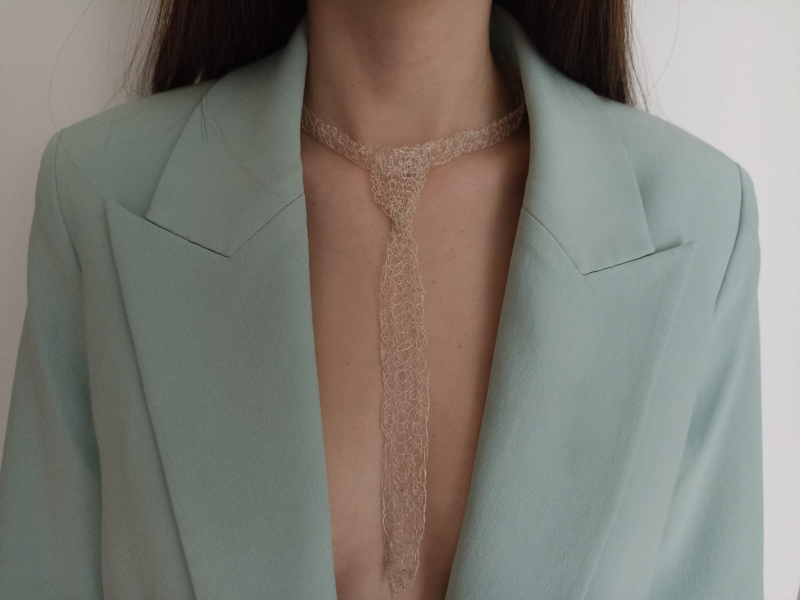
Ideal styling context | Tailored suiting, minimalist daywear | Silk, cashmere, bare skin, evening décolletage |
The Couture Parallel: From Avenue Montaigne to the Jeweler’s Bench
Hand-woven filigree belongs to the same philosophy as Haute Couture: the value lies in hours of human expertise that cannot be industrialized.
Think of the petites mains of Dior, who embroider a single gown over weeks, or the hand-finished tweeds that remain central to Chanel’s identity. In both, the hand is the point, not a romantic extra. High Jewelry houses honor the same principle in their own vocabularies: Van Cleef & Arpels with its celebrated Mystery Set technique, Cartier with the sculptural presence of its Panthère, Messika with the fluid mobility of diamonds in motion.
Where those houses often speak through gemstones, woven filigree speaks through the metal itself. The silver is the lace, the structure and the ornament at once. That is the territory of Julia Mosina Fine Jewelry, a Parisian Atelier where each piece is designed and Handcrafted in Paris, and where fluid, sculptural forms are woven into what the atelier calls metallic lace.

Styling Guide: How to Wear Woven Silver Filigree
Treat a filigree piece as you would couture lace: let it be the single statement against clean, quiet fabrics, and let it move.
Choose one hero piece. A voluminous woven earring or cuff needs no competition. Keep everything else minimal.
Pair it with matte textures. Cashmere, crêpe, raw silk and linen let the shimmer of the silver come forward.
Show the skin. Metallic lace looks best against a bare collarbone, an open neckline or a pulled-back chignon.
Play with scale. Because filigree is so light, you can wear dramatic volume all day without fatigue.
Mix eras with intention. A woven silver statement piece next to a vintage gold signet ring creates a collector’s dialogue between craft traditions.
From Manhattan to Dubai
In New York, wear sculptural filigree with black cashmere and a sharp coat; it softens urban severity. In Miami and Los Angeles, set it against white linen and sun-warmed skin for effortless resort elegance. In the UAE, it rewards evening dressing: its lightness suits warm nights, and its lace-like detail echoes the region’s long love of ornament and craft.
Atelier Secrets: How to Recognize True Hand-Woven Filigree
Authentic hand-woven filigree shows subtle irregularity, open depth and remarkable lightness. Cast imitations look flat, heavy and uniform.
When choosing a piece, a collector’s eye looks for:
Depth: real weaving has layers you can see through, not a pattern pressed onto a surface.
Lightness: a large piece should feel surprisingly airy in the palm.
Living light: reflections should shift and scatter as the piece moves.
Subtle variation: tiny differences between loops are a sign of the hand, not a flaw.
Provenance: a true atelier will tell you where, how and by whom the piece was made.
An Invitation from the Paris Atelier
In a world of endless replication, choosing hand-woven filigree is choosing a moment of human attention made permanent. It is jewelry that remembers the hands that made it and, in time, the woman who wears it.
We invite you to explore the collection at juliamosina.com, or to book a private consultation at our atelier in Paris, where a piece may be imagined around you, one silver thread at a time.
À très bientôt in Paris.



Comments